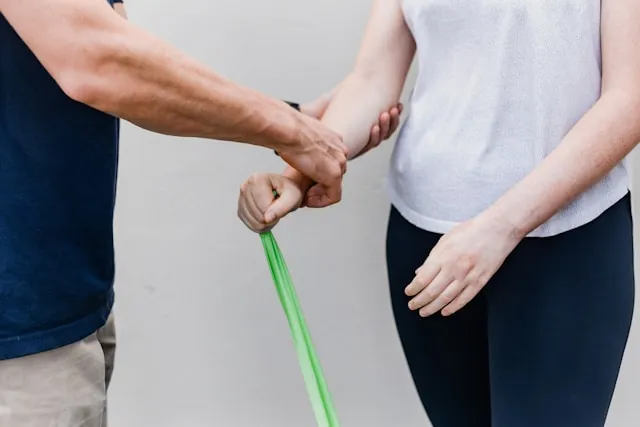
Assessment
A detailed history, then a thorough examination of movement, strength and the affected area. You leave knowing what is wrong, why it happened, and exactly what we are going to do about it.
With a sports injury, pain settling is not the same as being ready. We rebuild your strength across our London clinics and measure it against objective return-to-sport criteria, so you come back stronger and stay back, not just out of pain.

Overview
A sports injury is damage to muscle, tendon, ligament, bone or joint caused by sport or training, from an acute one-off strain or sprain to an overuse problem that builds gradually. Most respond well to accurate diagnosis and progressive rehabilitation, and for the recreational athletes and weekend-league players we see across central London, the aim is a return that holds, not just a pain-free week.
Whether you are dealing with a sudden injury or an ache that has crept up over a season, sports injuries fall into two kinds: acute injuries from a single event, like an ankle sprain or hamstring strain, and overuse injuries where load has outpaced the tissue, like tendinopathy or bone stress. The temptation with both is to wait until it stops hurting and pick up where you left off, but pain settling is not the same as being ready.
The injuries we treat, and the reasons they happen, tend to sit in a few groups:
When objective criteria say so. We rebuild strength and tolerance step by step, then test against return-to-sport criteria such as restored strength, symmetry and sport-specific function. This reflects BJSM consensus, which identifies rushing this stage as a driver of re-injury. Sam Harvey's elite-sport background and VALD testing let us measure that readiness objectively rather than guess.
We treat active people and athletes through physiotherapy and sports rehab across our Soho, Liverpool Street and Marylebone clinics, rebuilding capacity with strength training and confirming readiness with performance and strength testing, often alongside a related tendinopathy. Self-referral; no GP letter needed, and a free 15-minute consultation is available.
An ankle sprain, a hamstring strain and a bone-stress injury each need a different plan, and the wrong label costs you a season. We assess the injury and the demands of your sport, screen for anything needing imaging or referral, and set the plan from there.
Complete rest is rarely the answer. We modify your training: reducing intensity, swapping high-impact work, loading around the injured tissue, so you keep your fitness while the injury settles. You will know exactly what to keep doing, what to change and what to pause, so a weekend fixture does not set you back.
Once pain settles, structured strength work restores what the injury took: strength, control and load tolerance, built back step by step. This is the stage that most reliably restores robustness and cuts the risk of doing the same injury twice.
Return-to-sport decisions here rest on objective criteria: restored strength, limb-to-limb symmetry and sport-specific function, measured on VALD force plates and dynamometry. The BJSM consensus identifies rushing this stage as a driver of re-injury, so we test rather than guess.
A previous injury without full clearance is the classic set-up for the next one. We find the residual weakness or control deficit left behind, up the kinetic chain where needed, and close it off before you go back to full speed.
Pain settling is not the same as being ready. The programme finishes when you can meet the sprint, cutting, jumping or single-leg demands of your sport without symptoms, with the numbers to prove it. That is the difference between returning and returning for good.
Why it happens
Acute mechanical overload: a single high-force event such as a sprint, jump landing, change of direction, awkward fall, or contact
Cumulative overuse: training volume or intensity rising faster than the tissue can adapt, driving tendinopathy and bone-stress injuries
Returning to sport too soon after a previous injury, leaving residual weakness or altered movement
Strength, mobility, or control deficits up the kinetic chain (commonly hip, gluteal, calf, or trunk)
Sudden change in footwear, playing surface, or training pattern without an adaptation period
Inadequate warm-up, recovery, or sleep, which lower the tissue's tolerance to load

The assessment covers a detailed history and a thorough examination of movement, strength and the affected area. We explain what we find and agree a working diagnosis and plan you understand before you leave.
You go home with a written summary and a home-exercise programme built around your diagnosis and goals, so progress continues between visits.
Move better. Train stronger. Live fully. Pain relief that lasts is not enough on its own: we find the cause, then rebuild the strength behind the pain so it stays gone. No guesswork, no generic rehab.


Ready to optimise you? You can self-refer and book directly: no GP letter needed, and every new patient can start with a free 15-minute consultation call. The same fees apply across our Soho, Liverpool Street and Marylebone clinics.
Everything starts with finding the cause. Whether the goal is a marathon start line or a week at your desk without pain, we treat what is driving the problem, then build the strength that keeps it fixed.
A detailed history, then a thorough examination of movement, strength and the affected area. You leave knowing what is wrong, why it happened, and exactly what we are going to do about it.

Hands-on manual therapy combined with a progressive, tailored exercise programme. Sports massage, dry needling, shockwave or Reformer Pilates are added where they help your specific problem.

Coached, progressive strength work restores the load tolerance your body lost, paced to where you start. This is the stage that decides whether the fix lasts.

Each follow-up reassesses you against your baseline, with VALD testing where useful, so your return to work, sport or training rests on measured readiness. Discharge happens by mutual agreement when you can manage independently.

Treatment approach
Accurate diagnosis, hands-on treatment and a graded loading plan are the core of recovery for almost every sports injury, with progress tracked against objective return-to-sport criteria rather than how it feels.
See treatment detail →VALD strength and performance testing gives objective limb-to-limb and sport-specific data, so return-to-sport decisions rest on measured readiness rather than guesswork.
See treatment detail →FAQ
Complete rest is rarely the right answer. Modified training: reducing intensity, swapping high-impact for low-impact work and loading around the injured tissue, usually supports recovery better and preserves fitness. Your physiotherapist will tell you what to keep doing, what to modify and what to pause while the tissue settles and rebuilds.
We test against objective return-to-sport criteria rather than discharging on how it feels. That means restored strength and limb-to-limb symmetry, good movement control, and the ability to handle sport-specific demands: sprinting, cutting, jumping or single-leg load, without symptoms. Skipping these stages is a recognised driver of re-injury.
It depends on the injury. Mild strains and overuse problems often allow modified training within a week and fuller return over several weeks; tendon and bone-stress injuries typically need longer phases of progressive loading. We set a provisional timeline at your first session and update it at each reassessment, based on objective markers.
For most sports injuries, no. Clinical assessment usually guides management of soft-tissue injuries well, and routine scans often show incidental findings that complicate decisions without changing treatment. Imaging is appropriate after significant trauma, when red-flag signs are present, or when symptoms do not follow the expected recovery course.
Seek urgent care if you cannot bear weight after an injury, if a joint looks deformed or a bone may be broken, or if you felt a sudden pop with rapid swelling and loss of function. A hot, swollen joint alongside feeling unwell needs medical assessment rather than physiotherapy as the first step.
Get Started
Physio and Performance • 111 Charing Cross Road, Soho, London WC2H 0DT
Book NowAppointments typically available within 1–2 weeks