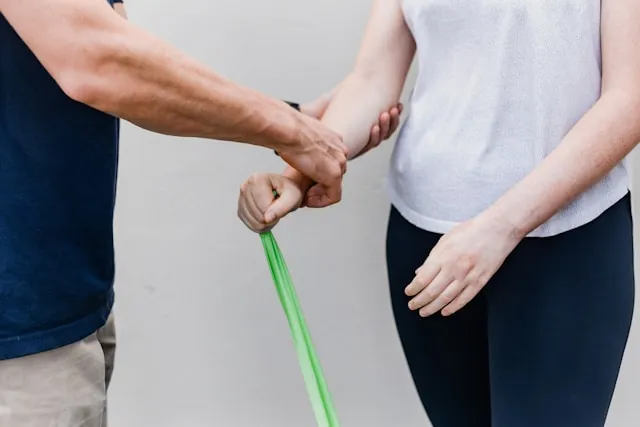
Assessment
A detailed history, then a thorough examination of movement, strength and the affected area. You leave knowing what is wrong, why it happened, and exactly what we are going to do about it.
Dry needling in London that releases the tight, hyper-irritable trigger points driving your muscle pain, delivered by our physiotherapists after a full assessment and paired with hands-on treatment and exercise so it opens a window for the rehab that lasts.


The assessment covers a detailed history and a thorough examination of movement, strength and the affected area. We explain what we find and agree a working diagnosis and plan you understand before you leave.
You go home with a written summary and a home-exercise programme built around your diagnosis and goals, so progress continues between visits.
A fine, single-use needle targets the tight knot within a muscle that produces local and referred pain, easing it so you can move more freely.
By settling trigger-point pain, needling opens a short window of easier movement that makes your hands-on treatment and exercises more effective.
Because it always follows a full physiotherapy assessment, every needle has a precise clinical target rather than being applied at random.
Where trigger points in areas like the upper trapezius, glutes or calves are driving your symptoms, needling can calm both the local knot and the pain it refers.
Needling sits alongside manual therapy and progressive exercise, never in place of them, so the lasting change comes from active rehabilitation.

Ready to optimise you? You can self-refer and book directly: no GP letter needed, and every new patient can start with a free 15-minute consultation call. The same fees apply across our Soho, Liverpool Street and Marylebone clinics.
Everything starts with finding the cause. Whether the goal is a marathon start line or a week at your desk without pain, we treat what is driving the problem, then build the strength that keeps it fixed.
A detailed history, then a thorough examination of movement, strength and the affected area. You leave knowing what is wrong, why it happened, and exactly what we are going to do about it.

Hands-on manual therapy combined with a progressive, tailored exercise programme. Sports massage, dry needling, shockwave or Reformer Pilates are added where they help your specific problem.

Coached, progressive strength work restores the load tolerance your body lost, paced to where you start. This is the stage that decides whether the fix lasts.

Each follow-up reassesses you against your baseline, with VALD testing where useful, so your return to work, sport or training rests on measured readiness. Discharge happens by mutual agreement when you can manage independently.
Move better. Train stronger. Live fully. Pain relief that lasts is not enough on its own: we find the cause, then rebuild the strength behind the pain so it stays gone. No guesswork, no generic rehab.


Written and medically reviewed by Sam Harvey, Physiotherapist & Clinical Lead · HCPC-registered · 15 Years’ Experience · Health and Care Professions Council (HCPC) and the Chartered Society of Physiotherapy (CSP), with dry needling delivered as an adjunct in line with current physiotherapy best practice.
FAQ
Dry needling uses fine, single-use sterile needles placed directly into myofascial trigger points: the tight, painful knots within a muscle. It is guided by a physiotherapy diagnosis and current understanding of pain, rather than traditional Chinese medicine theory. The needles look similar to acupuncture, but the clinical reasoning is physiotherapy-led and focused on muscular trigger points.
Not as a first-line treatment. NICE guidance on low back pain and sciatica (NG59) advises against acupuncture for non-specific low back pain, so we lead with exercise and manual therapy instead. Where a clear myofascial trigger point is contributing to your symptoms, needling may be considered as one adjunct within a wider plan, never on its own.
The needles are very fine, so most people feel a brief prick followed by a deep ache or a short muscle twitch. Serious side effects are rare when the technique is delivered by trained, registered clinicians using single-use sterile needles. Minor bruising, brief drowsiness or temporary soreness can occur and usually settles within a day or so.
No. Physio and Performance is a self-referral clinic, so you can book directly with no GP letter needed, and a free 15-minute consultation call is available first. Dry needling itself is offered only after a physiotherapy assessment, so your first step is an appointment where we decide together whether it is appropriate for you.
Usually only a few, because needling is an adjunct rather than the whole treatment. We use it to settle a trigger point and ease movement, then let your hands-on treatment and exercise do the lasting work. At each visit we reassess: if it is adding value we continue, and if it is not, we say so and adjust.
Tell us before any needling if you take anticoagulants, have a bleeding disorder, or are pregnant. Anticoagulants and bleeding disorders raise the risk of bleeding and bruising, and we apply particular caution during pregnancy. We screen for these at every visit and will adapt or avoid needling wherever it is not appropriate for you.
Get Started
Physio and Performance • 111 Charing Cross Road, Soho, London WC2H 0DT
Book NowAppointments typically available within 1–2 weeks