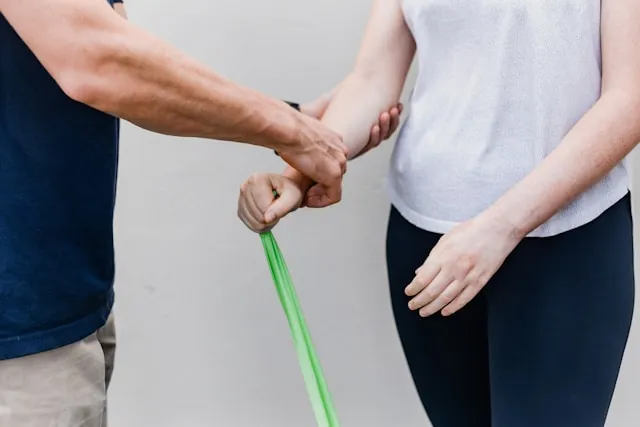
Assessment
A detailed history, then a thorough examination of movement, strength and the affected area. You leave knowing what is wrong, why it happened, and exactly what we are going to do about it.
Shockwave therapy in London for the stubborn tendon problem that loading alone has not settled, used clinically not as a gimmick and delivered by our physiotherapists alongside the progressive exercise programme that does the rebuilding, so you can move past a plateau.


The assessment covers a detailed history and a thorough examination of movement, strength and the affected area. We explain what we find and agree a working diagnosis and plan you understand before you leave.
You go home with a written summary and a home-exercise programme built around your diagnosis and goals, so progress continues between visits.
Focused acoustic pressure waves stimulate the body's own repair response in tissue that has stopped healing on its own, giving a stubborn tendon a fresh stimulus.
When a structured loading programme has taken you as far as it can, shockwave can be the adjunct that helps persistent symptoms finally settle.
We reserve it for recalcitrant cases like plantar fasciitis, calcific rotator-cuff, Achilles and patellar tendinopathy, where it is most likely to help.
Every course begins with a full physiotherapy assessment, and we will tell you honestly if your presentation falls outside the group shockwave suits.
Shockwave always runs in parallel with progressive loading, never in its place, because the rebuilding still comes from the exercises.

Ready to optimise you? You can self-refer and book directly: no GP letter needed, and every new patient can start with a free 15-minute consultation call. The same fees apply across our Soho, Liverpool Street and Marylebone clinics.
Everything starts with finding the cause. Whether the goal is a marathon start line or a week at your desk without pain, we treat what is driving the problem, then build the strength that keeps it fixed.
A detailed history, then a thorough examination of movement, strength and the affected area. You leave knowing what is wrong, why it happened, and exactly what we are going to do about it.

Hands-on manual therapy combined with a progressive, tailored exercise programme. Sports massage, dry needling, shockwave or Reformer Pilates are added where they help your specific problem.

Coached, progressive strength work restores the load tolerance your body lost, paced to where you start. This is the stage that decides whether the fix lasts.

Each follow-up reassesses you against your baseline, with VALD testing where useful, so your return to work, sport or training rests on measured readiness. Discharge happens by mutual agreement when you can manage independently.
Move better. Train stronger. Live fully. Pain relief that lasts is not enough on its own: we find the cause, then rebuild the strength behind the pain so it stays gone. No guesswork, no generic rehab.


Written and medically reviewed by Sam Harvey, Physiotherapist & Clinical Lead · HCPC-registered · 15 Years’ Experience · Health and Care Professions Council (HCPC) and Chartered Society of Physiotherapy (CSP).
FAQ
We use it for persistent tendinopathies that have not settled with loading rehabilitation: most commonly plantar fasciitis, calcific rotator-cuff tendinopathy, and Achilles or patellar tendinopathy. NICE interventional procedures guidance supports careful use in these recalcitrant cases. We do not offer it as a first-line treatment, and we will tell you if your problem is unsuitable.
The evidence is mixed. For some recalcitrant tendinopathies that have failed first-line loading, shockwave can be a useful adjunct, and that is the basis of NICE interventional procedures guidance. It is not a guaranteed cure and works best alongside a progressive loading programme rather than on its own. We reassess your response and stop if you are not improving.
Most people find it uncomfortable but tolerable, and the sensation settles as soon as the applicator lifts. Temporary redness, mild swelling, or aching over the treated area for a day or two is common and usually self-limiting. We screen for contraindications at every visit, which is how we keep the treatment appropriate and safe for you.
Shockwave is usually given as a short course of weekly sessions, but the right number depends on your tendon, your response, and how rehabilitation is progressing. We review after each session and only continue while you are improving. We will not commit you to a fixed package or add sessions the evidence does not support for your case.
It is gradual, not instant. Shockwave works by stimulating repair over the following weeks, so most people judge progress across a course rather than after one session. Some feel a little sore for a day or two first. We reassess your pain and function against your baseline as you go, alongside the loading programme that rebuilds the tendon.
No GP referral is needed: you can self-refer and book a free 15-minute consultation call first. Shockwave is not suitable in pregnancy, over an active infection or tumour site, with certain clotting disorders or blood-thinning medication, or for under-18s without specialist input. We confirm suitability at your assessment before any treatment begins.
Get Started
Physio and Performance • 111 Charing Cross Road, Soho, London WC2H 0DT
Book NowAppointments typically available within 1–2 weeks