Assessment
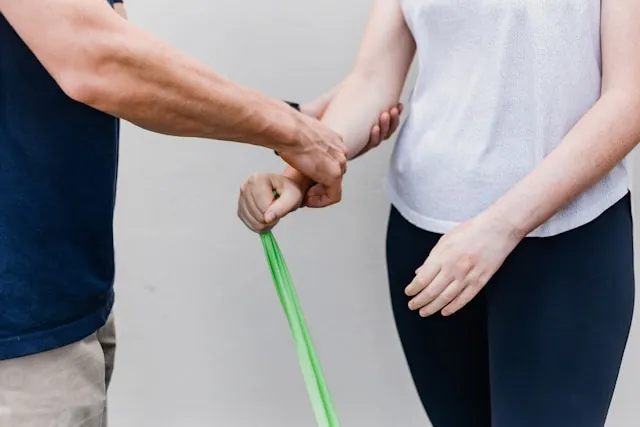
A detailed history, then a thorough examination of movement, strength and the affected area. You leave knowing what is wrong, why it happened, and exactly what we are going to do about it.
Tennis elbow, shoulder and knee pain are load problems that respond to graded rehab, not rest. We rebuild capacity so you serve and move freely again.

Overview
Tennis places two demands on the body: the repetitive overhead and rotational loading of the serve and ground strokes, and the explosive sprinting and lunging of court movement. Injuries reflect both, clustering at the elbow, shoulder, knee and ankle, and most are load-related rather than a single event.
Usually not completely, because relative rest beats complete rest for most of these problems. We find the structure and the load behind it; NICE and BJSM support graded loading for tendinopathy and most shoulder and knee pain. We rebuild rotator-cuff, forearm and lower-limb capacity and address grip or serve-load factors where relevant.
We treat club players, juniors and competitive athletes across our Soho, Liverpool Street and Marylebone clinics. Self-referral; no GP letter needed.
Why it happens
Repeated gripping and backhand loading at the outer elbow, the dominant driver of lateral epicondylalgia (tennis elbow)
Repetitive overhead serving that loads the rotator cuff and can irritate the shoulder when capacity is exceeded
Explosive lunging, sprinting and rapid changes of direction, which load the knee and risk lateral ankle sprains
A spike in playing or practice volume without a gradual build-up: the classic overuse trigger
Strength and control deficits in the rotator cuff, forearm, hip and lower limb that leave tissue under-prepared
A grip size, racket or technique factor that concentrates load on the elbow or shoulder
Tennis elbow is a load problem in the forearm extensor tendons, and it answers to progressive loading rather than rest, bracing or repeated injections. We rebuild grip and forearm capacity, review racket and grip factors, and most cases settle without any needle or surgery.
A shoulder that complains on the serve has usually run out of rotator-cuff capacity for the volume you are asking of it. We rebuild cuff and shoulder-blade strength, manage serve load through recovery, and return you to full overhead work in graded steps.
Lunging, sprinting and sharp direction changes load the knee and ankle hard. We rehabilitate sprains and kneecap pain with progressive strength and balance work, restoring the control that lets you chase a drop shot without thinking about the ankle underneath you.
Most tennis injuries tolerate adjusted play: fewer sessions, modified strokes, a temporary cap on serving. Full rest deconditions the very tissue you need. We agree what stays and what pauses, then expand your game as the tissue rebuilds.
Behind most tennis injuries sits a strength or control gap: cuff, forearm, hip or calf. Targeted strength work closes it, so the elbow, shoulder and knee stop absorbing load they cannot yet handle. That is what keeps the problem from returning mid season.
Playing volume comes back in stages, judged on strength, symptom response and how the tissue handles each step up. Warming up well and finishing worse is the signal we watch for. You return to full matches when the numbers and the tissue both agree.

The assessment covers a detailed history and a thorough examination of movement, strength and the affected area. We explain what we find and agree a working diagnosis and plan you understand before you leave.
You go home with a written summary and a home-exercise programme built around your diagnosis and goals, so progress continues between visits.
From pain to performance. Pain relief that lasts is not enough on its own: we rebuild the strength behind the pain so it stays gone.


You can self-refer and book directly: no GP letter needed, and every new patient can start with a free 15-minute consultation call. The same fees apply across our Soho, Liverpool Street and Marylebone clinics.
Everything starts with finding the cause. Whether the goal is a marathon start line or a week at your desk without pain, we treat what is driving the problem, then build the strength that keeps it fixed.
A detailed history, then a thorough examination of movement, strength and the affected area. You leave knowing what is wrong, why it happened, and exactly what we are going to do about it.

Hands-on manual therapy combined with a progressive, tailored exercise programme. Sports massage, dry needling, shockwave or Reformer Pilates are added where they help your specific problem.

Coached, progressive strength work restores the load tolerance your body lost, paced to where you start. This is the stage that decides whether the fix lasts.

Each follow-up reassesses you against your baseline, with VALD testing where useful, so your return to work, sport or training rests on measured readiness. Discharge happens by mutual agreement when you can manage independently.

Treatment approach
Sports physiotherapy is the core treatment: accurate diagnosis of the elbow, shoulder, knee or ankle problem, a graded loading plan that rebuilds tissue capacity, and a criteria-based return to serving, ground strokes and court movement rather than discharging on feel.
See treatment detail →Targeted strength work for the rotator cuff, forearm, hip and lower limb raises the capacity of the tissues tennis repeatedly overloads, addressing the underlying deficits behind tennis elbow and shoulder pain and reducing recurrence.
See treatment detail →For lateral epicondylalgia that has not settled with first-line loading, shockwave therapy may be considered as an adjunct alongside continued rehabilitation, in line with NICE interventional procedures guidance: never a substitute for progressive loading.
See treatment detail →FAQ
Tennis elbow, or lateral epicondylalgia, is a tendinopathy of the forearm extensor tendons at the outer elbow, irritated by repeated gripping and backhand loading. It responds best to progressive forearm loading, grip and technique adjustments and managing playing volume. Rest alone rarely resolves it, because the tendon needs graded load to rebuild capacity. Most cases settle without injection or surgery.
Rarely completely. Most tennis injuries respond better to adjusted load than to full rest, which only deconditions the tissue. We usually reduce playing volume, certain strokes or serve load to a level the tissue tolerates, then build back up through structured rehabilitation. Your physiotherapist will tell you exactly what to modify and when you can progress.
The serve is a high-speed overhead action that repeatedly loads the rotator cuff and surrounding shoulder structures. When playing volume or serve load outstrips what the cuff can handle, or when there are strength and control deficits, the shoulder becomes irritated. Treatment rebuilds rotator-cuff and shoulder-blade capacity and addresses serve load, rather than simply resting the shoulder.
Seek urgent care after a significant ankle or knee injury if you cannot bear weight or the joint looks deformed, or if a shoulder is locked or visibly out of place. Contact NHS 111 if pain or swelling is severe or rapidly worsening. For most elbow, shoulder and overuse pain, physiotherapy is the appropriate first step rather than emergency care.
Get Started
Physio and Performance • 111 Charing Cross Road, Soho, London WC2H 0DT
BookAppointments typically available within 1–2 weeks